
It has been a number of months since my last blog entry. I have been busy with trips to Peru, Panama and Mexico. I have numerous photographs and stories to share.
I thought it would be fitting to first share this photograph of the Rufous Vented Ground Cuckoo. On a recent Birding Life Tours trip to Panama we were heading up the famous Pipeline road and ran into an Ant Swarm and were likely enough not only to spot this rare bird but also get this one photograph. Not a spectacular shot but given the circumstances I was happy to get the capture. Our guide, Guido Berguido spotted him first. A rare bird and a great find for our checklist. About 20 seconds after this photograph was taken a tiny Hawk swooped in and attempted to capture one of the many birds following this ant swarm.
Join me on our trip to Brazil in Jun. www.birdinglifetours.com
Friday, March 26, 2010
Rare Rufous-Vented Ground Cuckoo Photographed


Thursday, September 24, 2009
Sandhill Crane

Its been a few months since I have been on my Blog, so I remembered I had these pictures of the Sandhill Crane I wanted to share. Not much of a summer in Ontario - lots of rain and not that warm. One of the highlights of the summer was this picture I was able to take of these Sandhill Cranes with their chicks. My wife and I were only 10 minutes from our Cottage and she spotted a car stopped on the side of the road looking at something. Naturally we thought it was deer or a bear since we see them often. Nope!!! We saw these new parents. As always I had my camera ready and was able to take a few shots before they became skittish. I have never seen Sandhill Chicks in Northern Ontario before so I was very excited. It seems to becoming a more regular occurrence.
Speaking of excitement, I will be hosting two tours coming up soon. Come tour with me in either Panama in December or Costa Rica in January. Only a few spots left!! Check us out at www.birdinglifetours.com. Hard to beat prices with a very different service offering.
Friday, June 5, 2009
Highlights from Point Pelee 2009
 The highlight of this years trip to Point Pelee for Spring Migration was the Prothonotary Warbler. Most of the time he was very far away and we needed our binoculars to get a good look, however, luck was on our side when he flew in for a quick look at us!!!
 I have never been this close to an American Coot. It was after a long day in the park and we were heading out and decided to have a quick stop at the boardwalk. We were very glad we did.
 This Black Billed Cuckoo is a lifer for me. Never ran across one before and would have missed this one if the group in front of us on the trail didn't spot him. He was motionless for a very long time. Lots of cameras captured him that fine day.
 One of my favorite photographs is this action shot of two male Red Breasted Mergansers. What is missing from the photograph is the female just to the left of the image and a third male to the right. Spring is wonderful!
Last and least, is this Black Throated Green Warbler. Rather a boring photograph, however it does capture a colorful male.
Join me on Birding Tours around the world. Check out my site at www.birdinglifetours.com for details and reduced recession prices.
Thursday, April 23, 2009
Birding Clothing - Basics and Extras
I am taking a bit of a diversion from my normal photography blogging to talk about Birding Clothing - Basics and Extras. Birding can take many shapes, from a quick stroll after breakfast to a formal birding trip into the rainforest. Naturally, your clothing needs to adjust as well.
The Basics
- comfort - first and foremost wear what is comfortable. Get rid of what looks good if it is not comfortable. You want to be watching the birds NOT thinking about how sore your foot is because your shoes are not comfortable.
- footwear - hiking boots, hiking shoes and rubber boots are all good choices depending on the terrain. Hiking boots and shoes are waterproof and will keep your feet dry in rain and in wet terrain. If you bird a lot in uneven terrain then get the extra ankle support provided by hiking boots. Rubber boots can get you much closer to the birds when your are birding in wetlands.
- clothes - earth tone clothes are best - please no bright colors or white. Stick with Khaki, brown, green, and gray. A comfortable hat will come in handy for the rain and sun. Pick the same colors as mentioned above. Make sure you wear clothes that don't squeak or rustle when you walk. Sometimes the most expensive rain gear can make a lot of noise when walking.
The Extras
- Vest - a lightweight vest with lots of mesh can be a good addition to your birding gear. Lots of pockets always come in handy for fieldguides, protein bars, camera gear etc. Also it provides an additional layer of clothing which will keep you warm.
- Repellent - Insect repellent is handy at times and fits easily in a vest pocket. I would recommend only using it when the bugs are really bad as it can be quite greasy and make marks on your plastic equipment - binoculars and cameras. That is because of the chemical "Deet" used in most effective repellents. Be careful!!
- Poncho - a cheap poncho that goes into one of your vest pockets comes in handy for those sudden rainfalls and helps keep your equipment dry too.
- First Aid Kit - a very small kit that contains painkillers, bandages, and tensor bandages are best and can fit into a vest pocket as well. Don't let a headache or a sore knee, ankle spoil your birding experience.
Join me and my guides on one of my birding tours to Central and South America. I have new recession price cuts for the remainder of my 2009 tours. Have a peek and see an example of the hardcover birding journal that is included with each tour at www.birdinglifetours.com
Monday, March 30, 2009
Cinnamon Hummingbird - Mexico
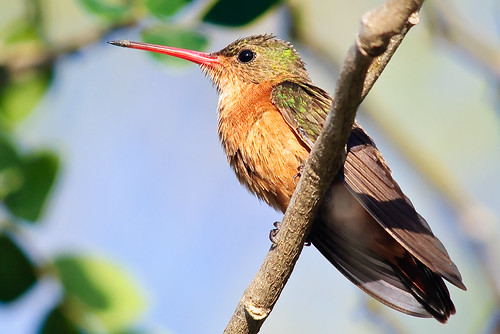
This photo was taken in the Yucatan. We were staying at one of the resorts and this particular Hummingbird was seen just off the resort during a birding walk. In my travels I am always amazed at why there are not hummingbird feeders everywhere. The different types of hummingbirds that can be attracted can be quite amazing in Central and South America yet most general resorts don't have them. Hummingbirds are generally liked by not just birders, but all types of people.
I find Hummingbirds extremely hard to identify. I usually need a photograph so that I can pick it out from the many types in Central and South America.
It is great now that our one Hummingbird in Ontario (Ruby-throated) is now making its way north and should be here sometime in April. A number of them nest very close to where we keep our Hummingbird feeder. In fact wearing a red t-shirt near a Hummingbird feeder can bring some interesting results. Try it sometime!!
I remember I was amazed that the first time I did not get my feeder out in early spring the Hummingbirds would go right to the exact spot of where the feeder was the year before and just hover. The guilt quickly made me ensure our feeders are up early every year.
Join me in one of my birding tours in Central and South America. Look for details at www.birdinglifetours.com


